What We Covered at the WIMAH 2026 Work Comp Summit
Takeaways from our WIMAH 2026 session in Honolulu: where AI fits on a claim, why voice agents are next, and why summaries need citations.
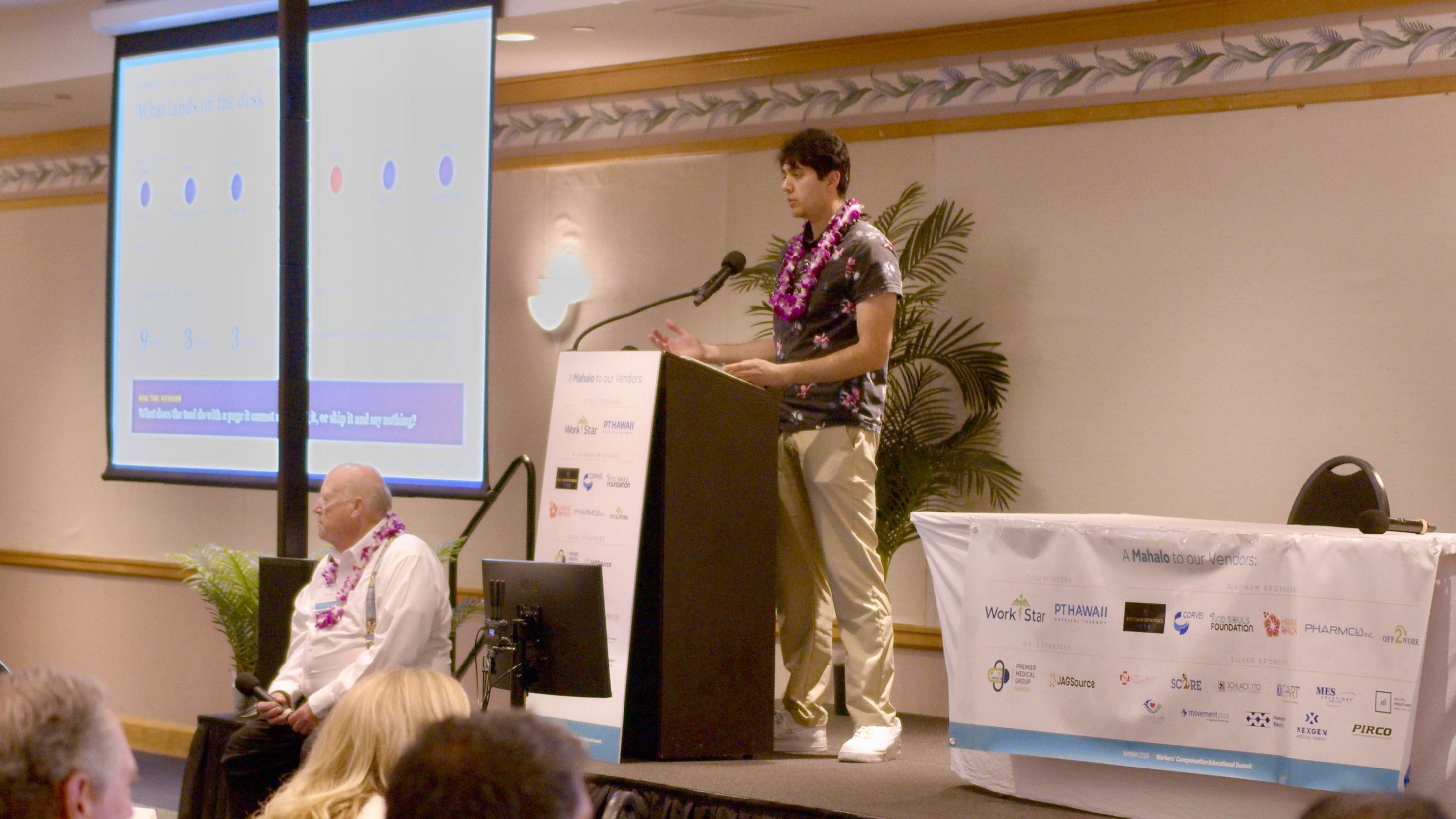
In case you missed it: Tom Ash of Consortium Solutions and I presented "AI Beyond the Basics: Turning Technology Into Better Claims Decisions" at the WIMAH 2026 Work Comp Summit in Honolulu. We covered where AI is being applied on a claim today, walked through an example claim to show how a summary can look right and still be wrong, and opened it up to the room. Here is what we talked about and why I think it matters.
AI applications in workers' comp
Most of the conversation about AI in workers' comp is still about document summarization. We covered a wider set of applications:
- Document review. Reading every page of the file, whatever format it arrived in, and flagging missing records and contradictions between reports.
- Claims triage. Ranking the desk so the file that needs a person gets looked at first. The adjuster still decides what happens on it.
- Working in existing systems. Email, fax, voicemail, and the claims system. The work happens in the tools claims teams already use, with no new portal.
- Voice agents. Making the routine calls to provider offices for records, work status, and appointments, then logging the call and following up.
Voice AI is the trend to watch
Of all of these, I think voice-based applications are the biggest change coming over the next 6 to 12 months. So much of workers' comp still runs on the phone: calling a provider office for a visit note, checking on work status, confirming the next appointment, following up when the fax never shows up. That work is repetitive and time-consuming, and a voice agent can handle much of it.
We played a synthetic call to a mock provider office, using a clone of my own voice. The agent worked the phone tree and waited on hold, said up front that it was automated, verified the claim, asked for the visit note, read the details back, and logged the call. Clinical questions and authorizations go to a person, who makes the decision.
An example claim with missing records
Next, we walked through a fictional claim built for the session. A housekeeper at a Maui resort lifts a mattress and feels her lower back go. Over nine weeks, seven documents arrive by employer portal, fax, clinic EHR export, and PDF, including a scanned fax from a clinic two years earlier. Some records show up weeks late, and nothing in the pile says which pages matter. That's typical of a real file.
Then we showed what an AI summary of that file might look like. It had a clean chronology, a history of a pre-existing back condition, an employer's exam that agreed, and a recommendation to review the additional therapy request. It read well and would get past a quick review on most desks.
It also left out the two facts that decide the file. It treated the earlier back pain as the end of the inquiry, but in Hawaii even a slight aggravation of a prior condition is compensable. And it never mentioned the MRI, the one objective finding in the record. Every statement in the summary was accurate, and those two omissions were still enough to send the claim the wrong way.
How to tell whether an AI summary is good
Most AI summaries look great at first glance, and reading one closely won't tell you what it left out. A summary missing a key finding reads just as well as a complete one.
That's why citations are a must. Every statement in a summary should link back to the page in the record it came from, so the person reviewing it can check the source in seconds instead of rereading the file. When we checked the example summary for citations, the gaps showed up quickly: the MRI was never cited, the aggravation question was never addressed, and nobody flagged that the employer's exam contradicted the imaging.
Audit logs matter for the same reason. You should be able to see what the AI read, what it couldn't read, what it produced, and who reviewed it before it went out. If a summary can't be traced back to the record and to the person who approved it, it's hard to trust and harder to defend later.
What adjusters, employers, workers and providers face
We spent a good part of the session talking with the audience about what AI changes for each group on a claim:
- Adjusters are carrying heavy caseloads and are in the middle of every conversation on the claim.
- Employers are dealing with the highest premiums in the country, plus penalties and litigation costs.
- Injured workers often don't know who to talk to, what happens next, or why a decision was made.
- Treating providers are dealing with documentation burden, return-to-work pressure, and treatment-plan objections.
Would an injured worker want a call from an AI?
We asked the audience what they thought about AI handling calls to injured workers. An employer said he was skeptical about how a call from an AI would be perceived. An injured worker in the room shared her view: getting communication, even from an AI, would be better than getting none. She wished she had been contacted earlier in her claim.
Hearing that from a worker gave the room more confidence in the idea. In our demo, the agent said up front that it was automated, and clinical questions and decisions went to a person.
Key takeaways
- Communication is the hardest part of workers' comp. The adjuster sits in the middle of the injured worker, the employer, the treating providers, and the nurse case manager, and every update runs through them. Voice-based AI can make that communication faster and give injured workers more visibility into what's happening on their claim, so they hear about their claim sooner. As the injured worker in our session put it, some communication is better than none.
- Support, not decisions. AI helps claims teams handle more claims while the deadlines still matter, and it supports their decisions. A person still makes the call.
- The failure is hard to spot. People don't know yet what AI can do, so some fear of the unknown is natural. The bigger risk is omission: a summary that leaves out a key fact still reads well, and without citations and verification, nobody catches it.
Why this matters
In Hawaii workers' compensation, claims teams are being asked to do more with fewer experienced people. The benefits of AI are faster communication and the ability to keep up with more claims while the deadlines still matter. Those benefits depend on every output being checkable against the record and a person reviewing it before it goes out.
Mahalo to the WIMAH team, the summit's sponsors, everyone in the room who shared their experience, and Tom for building this session with me. If you're trying to figure out where AI fits in your claims or med-legal workflow, book a time with me.